I don't usually play early access games. I find that doing so often leaves me with a feeling of disappointment, an incompleteness. After all, games are art, and looking at a piece of art that is unfinished means you miss out on a lot of what the artist intends for the final experience to be, or what seeing their project to completion might cause them to imbue the final project with unintentionally. Even if you could align the current pieces with a possible intent, ask the artist about it, and have them say "yes, exactly! You get it!" you're still not having the experience of the finished piece. It's kind of like saying you like a movie based on the youtube reviews you watched about it. You don't like the movie, you like an idea of the movie, filtered through the familiar voices you use to fill time and keep from introspecting while you go about your monotonous labors.
There are several other games I want to review instead of this early access game. Indie titles that are complete, that I'm interested in engaging with critically. I still haven't played those games. There are several other in-progress writing projects I want to be working on, that I think are much more important than this review. But I haven't touched those in weeks. I didn't even really want to play this game, but my wife is a sucker for both simulation titles and anything to do with aliens, so there was pretty much no stopping it, at least, once I'd done a tiny amount of research to determine the game didn't have any "AI" generated assets, or at least hadn't disclosed that it did, and didn't look particularly suspect.
I did obviously play this game, or you wouldn't be here on this crummy little website of mine reading an overly drawn out "review" of it. So far it's only been about why I didn't want to do either of those things. But I wanted to play a game with my wife in our limited free-time together, and she's not as much of a pretentious nerd as I am; the games I love bore her to tears. So we played the job-simulator with aliens. This extremely neglected website needed to be updated with SOMETHING, and I think I needed to experience the process of writing in a way I could tell myself had little to no stakes. So I am now reviewing the job-simulator with aliens.
We played the game for roughly two weeks, from about March 8th to March 21st, right before and a little bit after the game's automation update.
In its opening hours Roadside Research is pretty much exactly what I expected it to be; a fantasy capitalism simulator. You might be familiar with the formula: do X to get Y, to spend on Z, which will accrue Y faster, to spend on more Z, until X is almost unnecessary, and Z is producing Y while you look on with the smug satisfaction of a small business owner, content to retire having successfully boot-strapped your way from (theoretically) exploited, to exploiter. How did you accrue the capital to get your own business in the first place? Insert hand-waving narrative excuse to not think about it here. This time it's:

Many examples of the genre have secondary or (god help us) even tertiary systems to manage in the meantime, in order to deepen the simulation, like cleaning mechanics or micromanaging staff. Something simple to implement, but that fights boredom, like having to click an object occasionally so its texture map won't swap to the "dirty" version. Roadside Research has a couple of those usual suspects, but the elevator pitch one is that you're an alien, attempting to hide among humans for the nebulous goal of doing "research." Which means in addition to playing capitalist, you also get to inhabit the role of pervert by collecting customer's trash, taking pictures of them without being noticed, and filming them doing human stuff (like using toilets) while at your facilities. Now that sounds a little creepy, and it is, but the execution of it is where Roadside Research actually started to warm me up to its simulation.
The alien goal of research is implemented via a second currency, research points, gained by doing the creepy stuff, which can then be spent on alien tech that will improve the efficiency of gaining both currencies in various ways. Like brainwashing customers to buy more, or an alien trashcan that automatically collects and scans trash for you. But doing creepy stuff and installing these alien technologies also fills a suspicion meter, not to mention the fact that your aliens occasionally goop themselves wherever they might be. It's normal for aliens, but humans don't get it, so you're gonna wanna clean it up. Let the suspicion meter stay filled too high for too long and mysterious government agents will show up at your gas station to investigate. They might interrogate you, forcing you to play a mini-game to breathe or blink like a human. They might sabotage some of your tech, or if you're really suspicious, they may just hunt you down and blow your goop all over the floor.
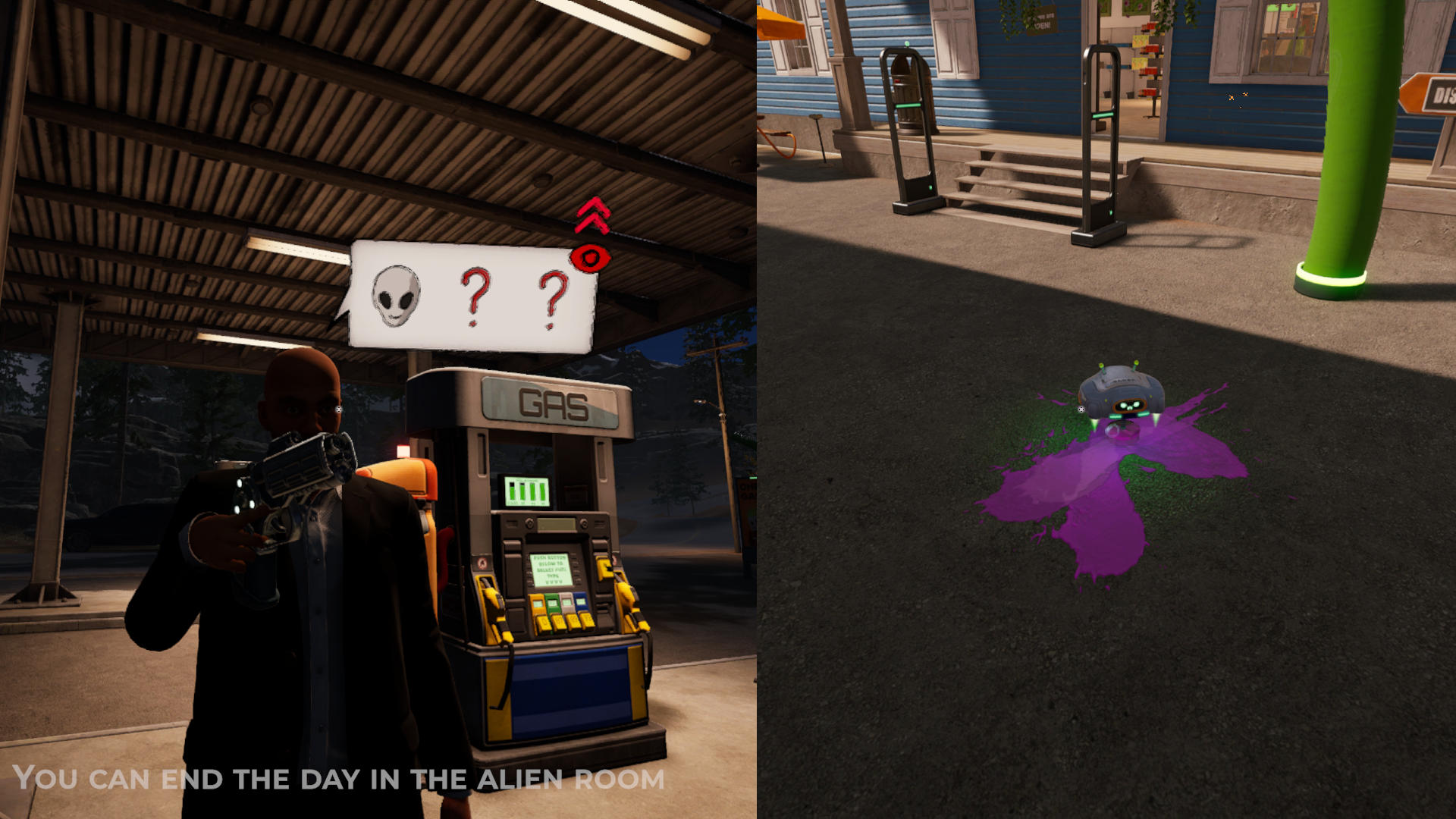
The twist of being extremely obvious aliens hiding poorly in plain sight is always handled with a light and silly touch, creating an interesting layer of friction to the usual grind of doing repetitive tasks to make a number go up. Several times while going to pump gas I found myself getting suddenly turned into goop by a car I didn't see coming, which make no effort to stop for you or other pedestrians (confirming the game is set in the U.S.). Or when my wife would fail to "breathe like a human," causing the agents to immediately execute us on the spot. Man, it really is just like living in the states. There are tools to avoid these negative events of course, and even a couple that can be used to neutralize agents, but getting killed really isn't that big of a punishment when your alien dad can just send another clone down to keep the store running. And besides, the goop can also be vacuumed up and turned into an energy drink that gives the player a speed boost, which makes restocking the store at the end of a day much more interesting than it might otherwise have been.
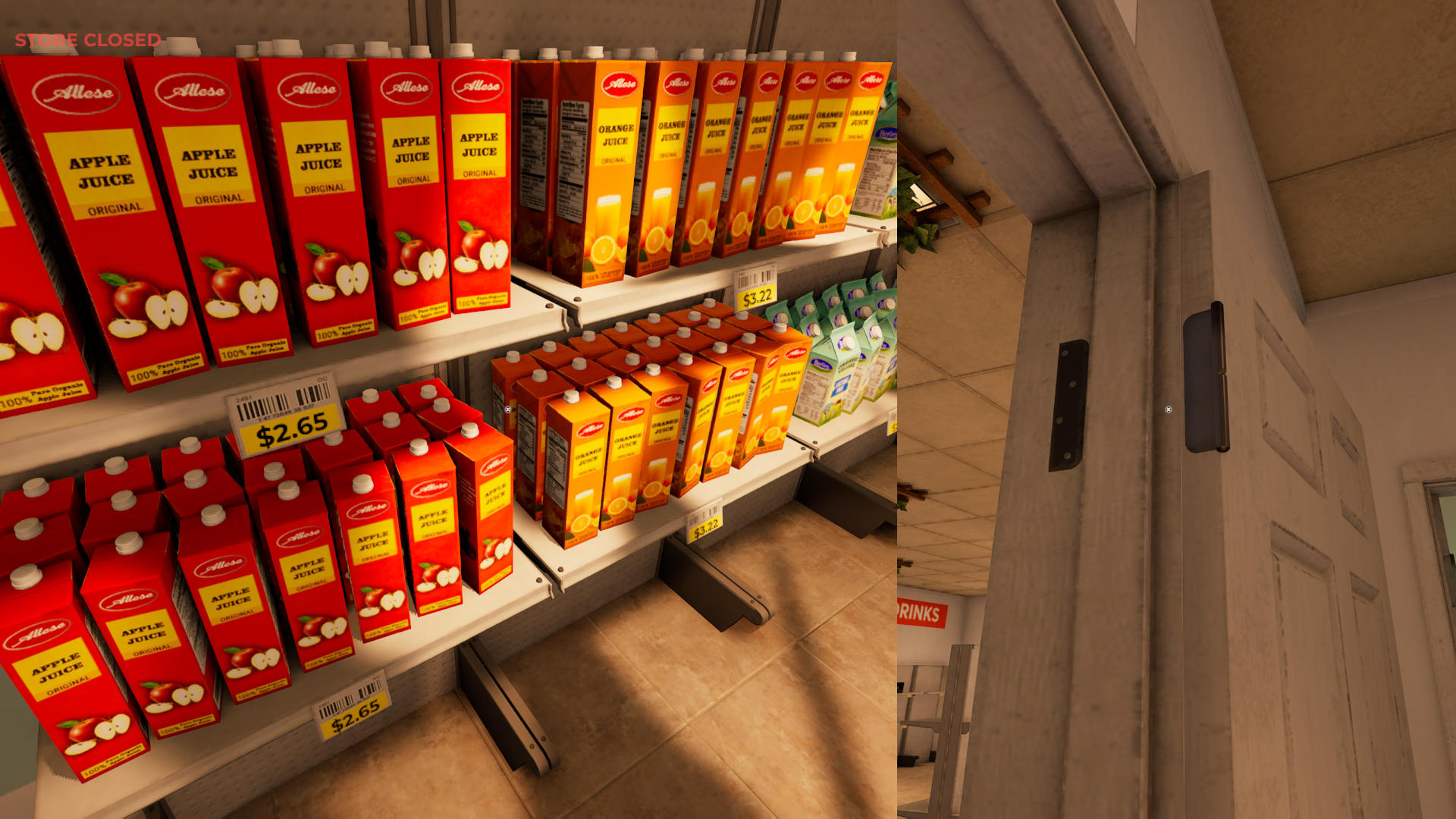
The more we played the more little touches I noticed as well, things that aren't really selling points, but slowly ratcheted my opinion on the game from "pretty good for one of these," to "man, i think these devs actually love making this thing." The first and simplest was how items that get stacked onto shelves aren't uniform. I know, that sounds like a stupid thing to fixate on, but the easiest solution to putting items onto shelves would be to make them uniformly sit in a grid. For whatever reason, the devs actually bothered to have the items on shelves slightly rotated or just a bit off of the center of their spot on the shelf. It's a weird but appreciated bit of polish, especially when compared to the doors in the game, which are most certainly pre-made assets that have been somewhat poorly flipped around? Because they opened the wrong way, I guess?
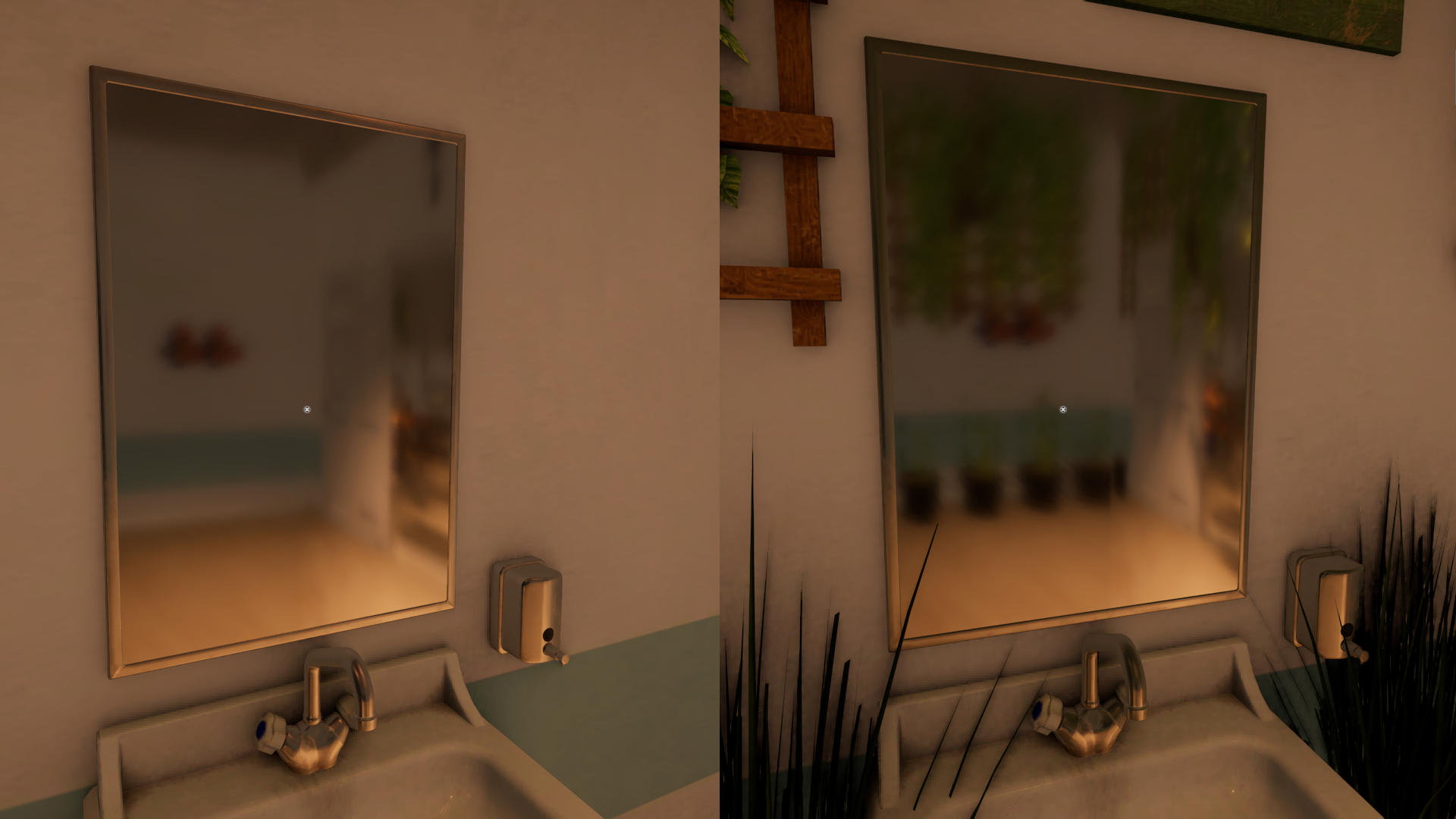
And then there's the reflective surfaces. Look, I'm not the smartest guy when it comes to game dev, but I do know that reflections are hard to pull off, and there are a lot of tricks to bullshitting your way to making passable ones without clogging up all the processing power that real-time ray tracing would require. And this is the job simulator with aliens. They did NOT have to do ANYTHING with reflections, they could've just baked in some textures and called it a day. But the reflection in the bathroom mirror, as well as glass items like the carafes on the decorative coffee machines, actually update to reflect the items around them. I'm pretty sure the game is effectively taking a snapshot at predetermined points, like maybe when the game host decides to end the day and start the next one, so if you move things around they don't change immediately, but still. It was more work than they needed to do, and it looks slick. It contributes to the spaces of this goofy world feeling just a bit more believable.
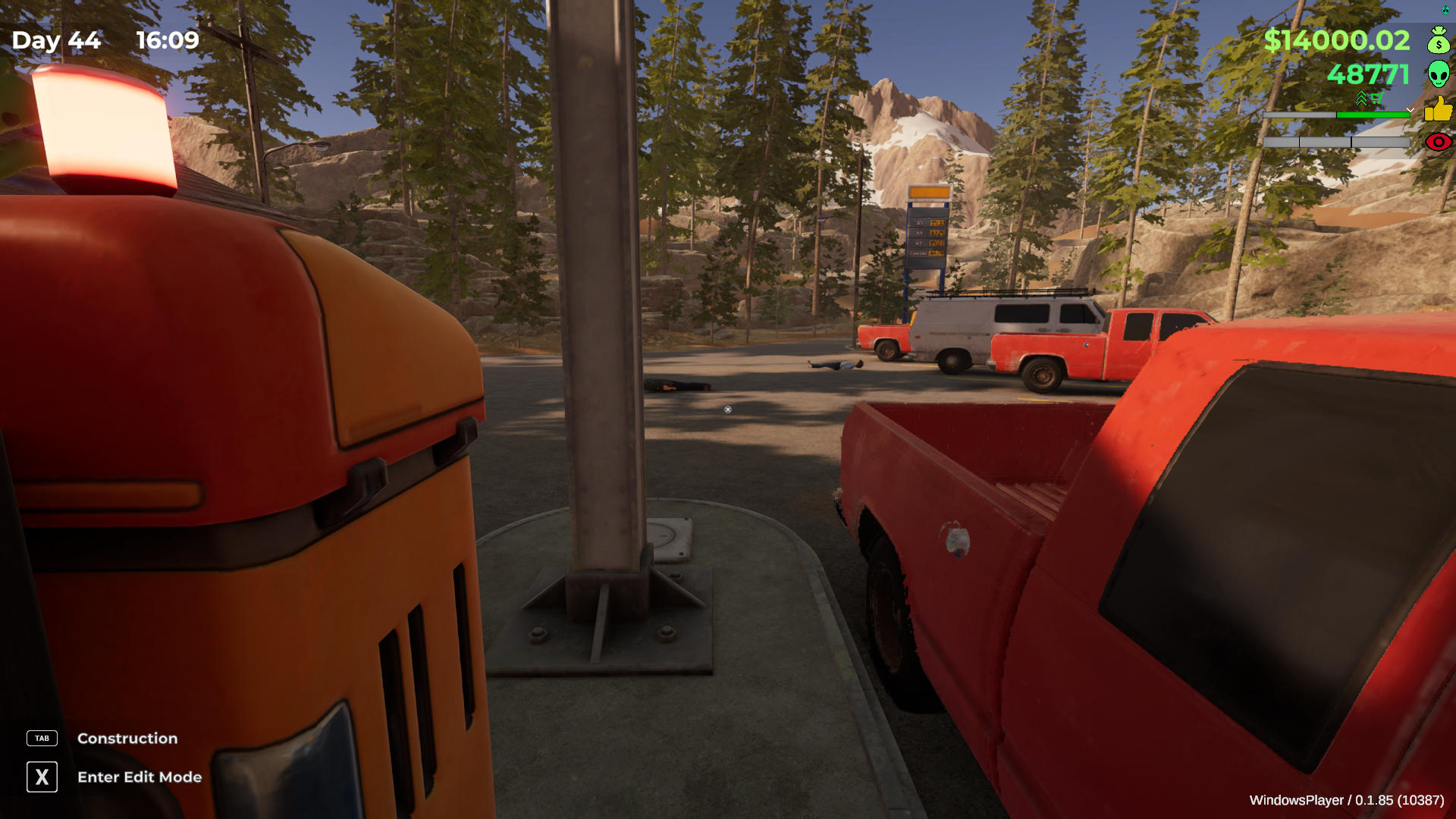
And the goofy stuff contributes to the "believability" in many ways too. All of the tools that players use are physics objects that exist in the game world, and players have no inventory, meaning anytime you need to clean up your goop, or take photos of a customer just trying to pay for their gas, you have to grab the item, use it, and then put it somewhere. And those objects also interact with customers and agents, so if a customer caught you snooping on them you could knock them over the head with the camera by throwing it, then run to get the neuralizer and wipe their memory, neutralizing the progress of the suspicion meter. One place the game followed the mold of other games in this over-crowded genre was in pedestrian and car interactions, with cars just sliding through people. Which is always a bit of a fourth-wall break, a little lame, a little disappointing, mostly just a reminder you're in a simulation. As a part of the automation update, however, or a hot fix around the same time maybe, pedestrians were made to interact with the cars that come zooming in to get gas. So now a driver might plow through several customers on their way to the pump, sending them rag-dolling across the parking lot or into the store, before splattering you all over the pavement and then calmly walking up to the new self-serve pump and filling their tank. Customers just get back up and do a little "aw dang, what the heck," animation of annoyance before going right back to their business, while a stylized alien roomba comes floating out of the store to start clearing away your colorful smear.
The automation update was interesting for another reason as well, though maybe just for me. I fully expected it to have the silly alien-tech style of automation that was implemented, but I also expected it to incorporate some sort of staffing mechanics, like many of these games often do. It's one of the things I dislike the most about the genre, turning the player by necessity of game mechanics into an exploiter of wage labor, while having basically nothing to say about that in the least. Some of these games feature mechanics where customers will be irritated by delays, you know, for the realism, the immersion, it's got what gamers crave, while making cashiers or stocking staff absolutely mindless drones. They "get paid," via a currency deduction at set points, but where the fake customers at least have the facade of agency to be impatient cunts occasionally, the workers who make the player's game function more smoothly are automatons. Designing it this way truly leans into the managerial mindset, the capitalist mindset; they do not matter, they are a means to an end, numbers on a spreadsheet, I spend Y for Z, so Z better fucking do X so I can get more Y. And yeah, it's a video game, I do not think anyone is a monster for enjoying the cathartic experience of control, expansion, and number go up. I do, however, think it is interesting that games in this genre rarely take the time to bother examining any of the social relations of labor that are present, inherently, in the systems they so painstakingly attempt to simulate. You simply do whatever is next on the checklist to make numbers go up, don't think about it too much, don't expect it to build to anything, or say anything, just check-out whenever you grow tired of playing emperor. You don't currently do this in Roadside Research. The cleaning robot is even a bit slow, so when a player sees a mess, or makes one, cleaning it up is often more interesting and productive than leaving it. Not to mention you don't get the fun speed boost energy drinks from the robot. Even with all of the inventory unlocked, restocking the store everyday isn't too much time or work, and is especially fun with the energy drinks. It doesn't yet beg a player to offload that labor onto something or someone else, instead focusing on the joy of the task, and the joy of optimizing tasks. I'm most certainly projecting a bit here, but I feel the devs behind Roadside Research have a higher capacity for storytelling than the average dev in this genre, and more ambition as designers. The conception of the player as an alien presence, observing and examining, "researching" the behaviors of humans, is one ripe not just for all of the self-aware jokes and joyful play present in the game currently, but also as an opportunity for an examination of work and labor relations generally, as only a game centered on labor could explore.
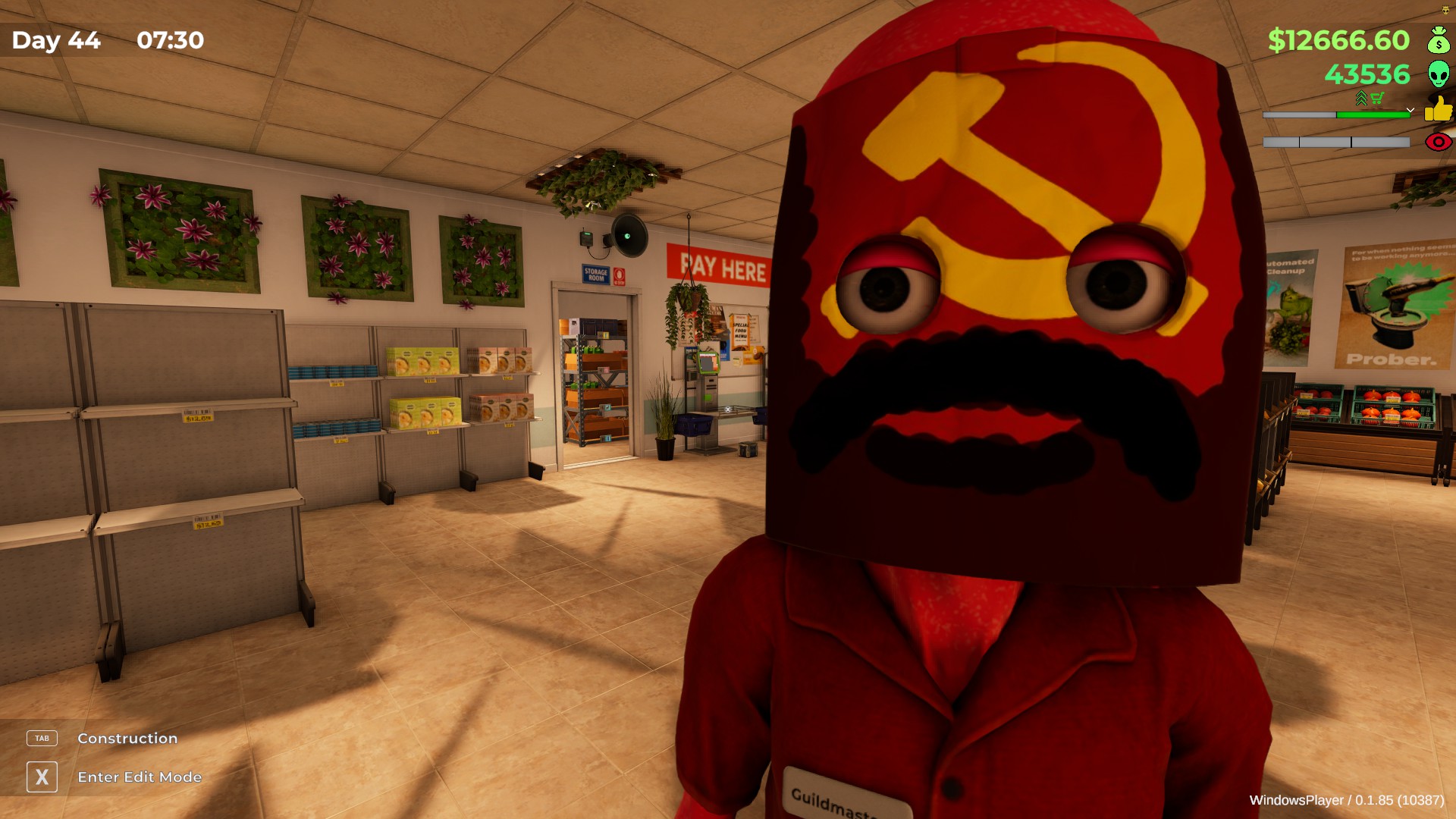
I did not expect to like this game. I expected that it would be much like the other games in the genre; busy work for the hands and eyes while something more interesting occupied the majority of my attention. A fidget-toy to accompany a youtube video on the other screen, or a conversation with my wife where I am the put-upon manager figure trying to corral the eccentric owner while she customizes and decorates her little simulated store. What I got was something that actually required most of my attention to play, and rewarded it with impromptu bits and really stupid jokes about probing, gooping, and throwing things at agents of the federal government. I don't think I'll revisit Roadside Research while it's in early access; not really my scene, as it's currently in the nebulous state of having nothing to do or work towards once all of the upgrade trees are climbed. But I have been convinced that with more time and commitment to the bit, Cybernetic Walrus could possibly make a capitalism simulator that actually goes somewhere interesting for a change.